
“Enshittification”, Explained
The Economics Behind the Buzzword

This post is a shortened, non‑technical summary of a longer article I published in the CPI Antitrust Chronicle (October 2025), in which I take a closer economic look at Cory Doctorow’s “enshittification” thesis and its implications for digital platforms, competition, and regulation. The original piece goes into more detail on the theory and evidence; here I focus on the main ideas and examples that matter most for readers interested in platform strategy and policy.
Platforms like Uber, Airbnb or Facebook connect different groups of users and manage the network effects between them: the more people join, the more useful the platform becomes. This dynamic explains the rapid rise of digital platforms—but also why some of them become highly dominant, raising concerns about how fairly they share the value they create.
Cory Doctorow’s “enshittification” thesis captures this concern in three steps: platforms start out good to users, then tilt toward business customers, and finally squeeze both sides for their own benefit before collapsing. I use basic platform economics to show where this story fits reality, where it exaggerates, and how regulation can help.
A correct start … but a questionable sequel
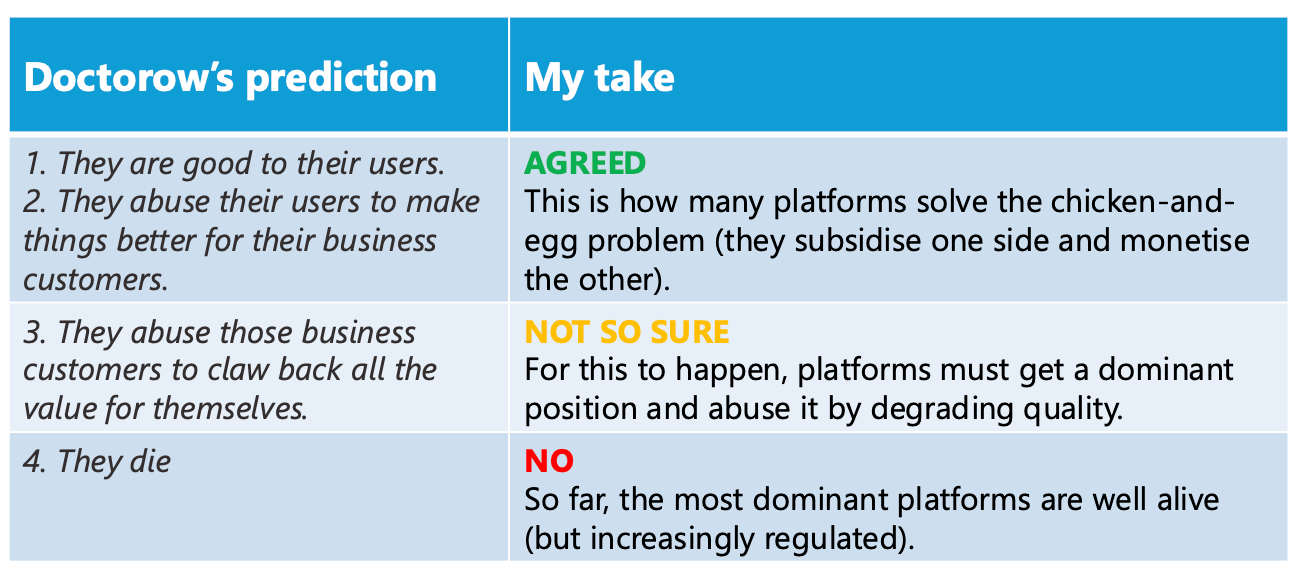
“First, they are good to their users; then they abuse their users …”
At launch, every platform must solve the chicken‑and‑egg problem: why should riders join if there are no drivers, and vice versa? The usual answer is to pick one group as “bait” (for instance, drivers or sellers), offer it very generous terms, and then gradually shift value toward the “money side” that pays the bills.
Over time, platforms may even reverse who is subsidised—as when ride‑hailing apps cut driver bonuses once they have enough drivers locked in and refocus on attracting passengers. So Doctorow is right that the treatment of user groups changes over time, even if it isn’t always outright “abuse.”
“Finally, they (…) claw back all the value for themselves.”
However, the idea that platforms can claw back all the value ignores that value is co‑created: if users feel exploited and leave, the network shrinks, and the whole pie gets smaller. Users also care about who else is on the platform (network benefits) and intrinsic quality (design, privacy, innovation), and platforms constantly trade off these dimensions.
What matters is the trajectory of value: generous early deals followed by tougher monetisation can still be acceptable if network effects remain strong and total value continues to grow. User exploitation becomes a real risk when early bargains are weak and later extraction is strong; this typically happens under two conditions I discuss next.
Abuse of market power by an uncontested platform
When a platform tips into a near‑monopoly, it gains tools to protect and exploit that position: exclusivity deals, high switching costs, tight control over data, and influence over standards. Because one side often pays a monetary price of zero, this power tends to show up less in price hikes and more in quality decline.
Dominant platforms can relax seller curation, clutter feeds with ads, bias rankings toward paying clients or their own products, and monetise user data more aggressively while underinvesting in security. They can also buy up promising rivals and shut them down, reducing innovation and choice. All of this fits Doctorow’s story—though most such platforms do not suddenly die; they often survive in a degraded but still profitable state.
Cut‑throat competition and race to the bottom
Enshittification can also emerge when competition is too fierce rather than too weak. In China’s food‑delivery wars, for example, Meituan, Ele.me and JD.com spent billions on subsidies and discounts, initially delighting consumers but squeezing merchants, driving down riders’ pay, and eroding their own profits.
In such races to the bottom, platforms fund aggressive user acquisition by cutting corners on service quality, labour standards and innovation. Because of network effects, a decline on one side (say, riders) can quickly degrade the experience on the other (customers), creating a vicious circle in which all platforms end up worse, and users receive less value.
Regulatory responses
If decay can come from both monopoly power and destructive rivalry, regulation must address both without killing what makes platforms valuable. The EU’s Digital Markets Act, for example, imposes ex ante obligations on “gatekeepers” to guarantee fairness (no self‑preferencing, more transparency) and contestability (interoperability, easier switching).
More generally, regulators need to prevent platforms from competing by eroding privacy, quality or labour conditions, while still allowing them to reduce transaction costs and foster innovation. The goal is not to micromanage platforms, but to put guardrails on the most harmful strategies that drive enshittification.
The following table summarises my analysis.
Conclusion
Doctorow is right to highlight a strong tendency: as platforms mature, they often shift from generosity to extraction, and quality can slide. But economics shows this is not a mechanical law of nature—some big platforms maintain or improve user experience, and dominant ones rarely collapse solely because they became “too greedy.”
In practice, a platform’s path depends on market structure and rules: monopoly power favours a slow, persistent decline, while hyper‑competition can trigger a rapid race to the bottom. Thoughtful regulation is essential if we want platforms to keep creating value for their users instead of living up to the bleakest version of the enshittification script.